
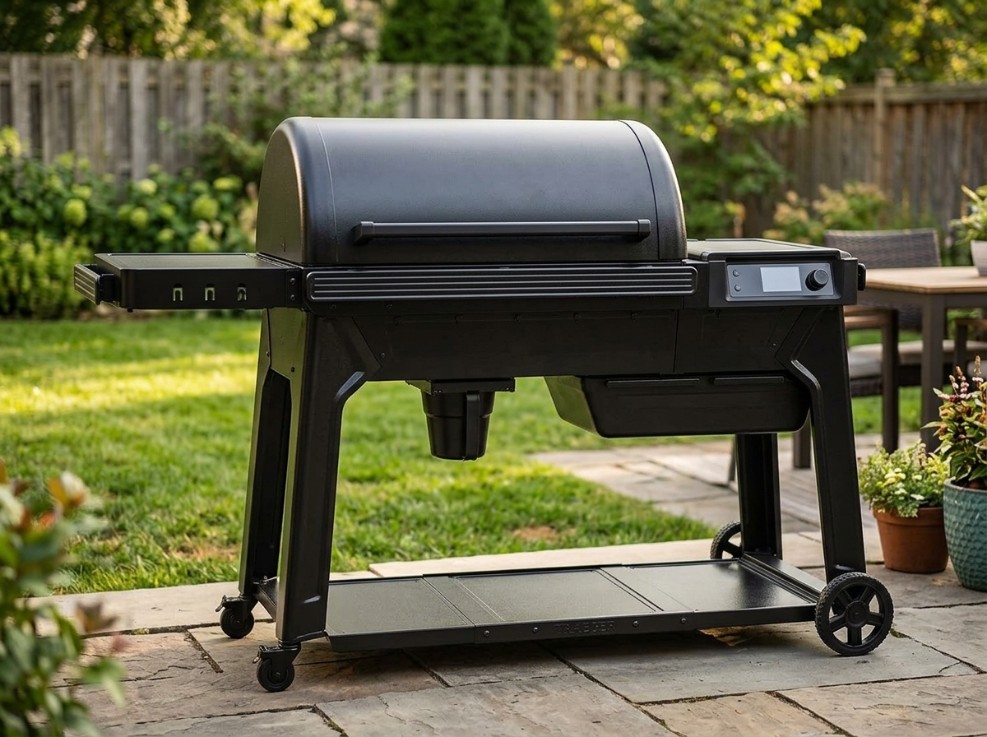
You're probably staring at two warranty tables and assuming the bigger number wins. We checked where each brand's warranty lines up against what its own owners report breaking. Traeger backs its current Woodridge Pro with a flat 10-year warranty; Weber backs the Searwood XL 600 differently, at 3 years on electrical parts behind the complaint that recurs in the owner threads we read. That's the real trade-off in "Traeger vs Weber pellet grill" right now.
Both brands now sell two current pellet grill tiers apiece.
Traeger's lineup: Woodridge Pro and standard Woodridge. Weber's: Searwood XL 600 and Smoque XL.
The Woodridge Pro and Searwood XL 600 are the primary pair, matched closely on price and area. The Woodridge and Smoque XL sit one tier down. The older Ironwood XL and SmokeFire pairing most guides still name isn't reliably purchasable; see the legacy note near the end.

The Warranty-to-Failure-Mode Trade-off
Here's what a warranty table and a reliability roundup miss when written separately: the term that sounds safer on paper isn't always the one protecting the part most likely to fail on your grill.
Traeger's flat 10-year limited warranty applies to both Woodridge tiers compared here, the standard Woodridge and the Woodridge Pro. It covers defects in materials or workmanship with no part-by-part step-down.
Weber's warranty on both the Searwood XL 600 and the Smoque XL is tiered instead. The cook box gets 5 years. Electrical parts, cooking grates, the burn pot and the heat diffuser get 3 years.
Lined up against owner reports, that structure matters more than the term length alone suggests: Weber's shortest tier, the 3-year electrical coverage, is exactly where the recurring Searwood XL 600 complaint in the weberforum.com threads we found lives.
Two separate weberforum.com owners (2024 and 2025 threads) describe the grill running below its displayed setpoint on long cooks, and one of them measured his unit 50 to 100 degrees off with a separate probe thermometer. Weber support told one owner, after exhaustive back-and-forth, that there was no issue.
Traeger's flat term covers its own failure classes just as fully. Woodridge Pro owners report ignitor failures needing a Traeger-support-only part, a three-to-five-day wait, plus warped grates.
At least two owners, one on a Woodridge and one on a Woodridge Pro, report the grill catching fire during shutdown. The base-Woodridge report named the pellet hopper as the origin. Our Traeger auger jam guide covers a related, more common failure point across the lineup.
None of that is a reason to write off either brand, but weigh the failure against coverage: term length alone doesn't tell you enough.
Two Tiers Each, Matched on Price and Area
Lining up the current lineups shows the specs land close together within each price band. The Traeger Woodridge Pro cooks on 970 square inches and tops out at 500°F. It comes with Super Smoke Mode and a side shelf.
The Weber Searwood XL 600 cooks on 972 square inches, split 630 on the main grate and 342 on a second level. Weber rates it to 600°F.
One tier down, the standard Traeger Woodridge cooks on 860 square inches, also capped at 500°F. It skips the Pro's side shelf, Super Smoke Mode and pellet sensor. The Weber Smoque XL cooks on 918 square inches total (595 primary, 323 warming rack) and is capped at 500°F too. Weber positions it as a smoker-first design, not a searing grill.
Neither brand has a real size edge at either tier for the group you're feeding. On price, direct from each brand's site, the entry tiers land close enough to call a match, and the step up to premium costs a similar proportional jump on both sides. Price alone won't decide this.
Construction differs more than specs show. The Woodridge weighs 138 lbs and the Searwood XL 600 weighs 157.80 lbs, both heavier than the Smoque XL's 110.00 lbs, a rough proxy for steel gauge, and the Smoque XL draws none of the warping complaints. The ceiling gap and warranty above separate them.
Traeger Woodridge Pro

If this is the one you're eyeing: it's Traeger's second Woodridge-series tier, priced close to the Searwood XL 600 direct on traeger.com. It carries the same flat 10-year warranty Traeger states on the product page, and you get Super Smoke Mode plus a side shelf standard, which the base Woodridge skips.
Owner sentiment on r/Traeger and bbq-brethren.com splits cleanly. One owner said it works great, though they'd have paid for the Elite tier in hindsight. Others report the warped grates, ignitor failures and hopper fire covered above, one needing a long back-and-forth before Traeger replaced the unit.
If reviews matter to your decision, the Woodridge Pro's own Amazon listing carries a 4.4-out-of-5 average across 217 ratings.
Traeger Woodridge Pro — What Works
- 970 sq in of cooking space with Super Smoke Mode
- Flat 10-year limited warranty with no part-by-part step-down
- Side shelf adds prep space the entry Woodridge tier skips
Traeger Woodridge Pro — Watch Out For
- Multiple owners report ignitor failures needing a Traeger-support-only replacement part, with a 3-to-5-day wait
- At least one owner reported a fire during the shutdown cycle, and others report warped or cracked grates
Weber Searwood XL 600

Searwood remains Weber's flagship pellet line for US buyers. SmokeFire no longer appears on Weber's US wood-pellet category page, and its Amazon EX6 listing reads "Currently unavailable," pointing to a dropped lineup rather than a temporary stockout.
Searwood's hopper sits on the side, holding 20 lb of pellets. DirectFlame cooking has no large sheet diffuser blocking the flame, aiming for more direct sear character. A Rapid React PID controller targets a heat-up around 15 minutes. Weber rates the Searwood XL 600 to 600°F, 100°F past every current Traeger model here, paired with a SmokeBoost setting for extra smoke on long cooks.
One owner's temperature-accuracy report, with measured swings detailed above, is worth weighing against the extra 100°F of headroom Searwood offers.
Searwood launched too recently for multi-year data, but it's worth knowing before you buy. Run your guest count through our Grill Size Calculator to see which model fits.
Weber Searwood XL 600 — What Works
- 972 sq in cooking area and a 600°F rated ceiling, well above every current Traeger model
- Side-mounted 20 lb hopper and a pull-and-clean grease/ash tray
- DirectFlame system and a Rapid React PID controller targeting a roughly 15-minute heat-up
Weber Searwood XL 600 — Watch Out For
- One owner measured the grill running 50-100°F below its displayed setpoint on long cooks, in Weber's shortest 3-year electrical warranty tier
- One owner's report to Weber support was met with no acknowledged issue
One Tier Down: Traeger Woodridge vs Weber Smoque XL

The same trade-off repeats a notch cheaper on each side. The standard Woodridge carries the same flat 10-year warranty as the Pro tier, on an 860-square-inch cook space, minus the Pro's extra features.
Ten verified-purchase Amazon reviews tagged "Style: Woodridge" run mostly positive, one noting occasional temperature overshoot while still calling it a grill they love. On r/Traeger, one base-Woodridge owner named the pellet hopper as the fire's origin during shutdown, the same failure class the Pro tier saw; Traeger disputed it first, then replaced the unit.
A separate owner reported a probe reading 75 to 100 degrees below the display. One base-tier owner wishes they'd paid for the Pro, though the app still draws praise on its own.

The Weber Smoque XL is Weber's smoker-first pick at this tier, not a searing grill. It's 918 total square inches, capped at 500°F, with the same tiered warranty as the Searwood XL 600. Owner reports skew positive and don't repeat the Searwood's setpoint complaint, though the review base is thinner and newer.
One reviewer switching from a Pit Boss vertical propane smoker reported a solid smoke ring on brisket. A former stick-burner owner called the smoke flavor less pronounced, though pleased with the convenience.
One real caveat: two r/pelletgrills posts in September 2026 flagged a steep Smoque XL markdown at Walmart, well under weber.com's price (one a purchase, one a price sighting), a possible discontinuation signal worth rechecking before you buy. Still in-stock direct on weber.com.
App and Connectivity
If you like checking a cook from the couch, both brands gate their lineups behind an app rather than a knob. One Woodridge owner review calls the app "awesome," and separately praises the grill itself for heating up fast and holding temperature well; Traeger's own listings confirm Bluetooth meat-thermometer compatibility on the base tier, so you can ditch the wired probe too.
You get the same basic deal from Weber: both the Searwood XL 600 and Smoque XL connect through the Weber Connect app. The Searwood runs that connection from a digital LCD controller; the Smoque XL's page lists only a digital temperature display, a plainer readout. Weber's Searwood XL 600 Amazon listing also advertises Bluetooth, matching the Traegers' meat-thermometer pairing; Weber makes no such claim on the Smoque XL's listing.
Searing vs Smoking, Not Just a Spec Number
The 100°F gap between Weber's ceiling and Traeger's cap reads like a simple searing edge for Weber if you're just comparing spec sheets, and on paper it is. But owner reports complicate that read.
Two Searwood owners on weberforum.com describe the grill running below its setpoint on the long, low cooks a pellet grill is usually bought for. That's the opposite end of the range from where the extra 100°F helps. One current Searwood owner said they rarely use that headroom and, looking back, wishes they'd bought the Smoque XL instead.
If searing is occasional, not weekly, the setpoint-accuracy risk may matter more than the ceiling number.
What Neither Grill Has Yet
We checked for an independent lab test of any current model and found none, not even from Consumer Reports. Its only pellet-grill lab data here covers the discontinued SmokeFire EX6, a product neither brand sells. Grate material is a gap too: none of the four product pages name what the grates are made of, so we can't call it porcelain, stainless, or cast iron here. Grates surface only as a Woodridge Pro failure point, never as a published spec.
Every claim above comes from the brands' own product pages, verified-purchase Amazon reviews, or owner forum posts, never a lab test, so weigh it a little more carefully than a lab-verified number until that test exists.
The Old Flagship Pairing (Legacy Note)
Earlier guides, including an earlier version of this one, compared the Traeger Ironwood XL against the Weber SmokeFire, then later the Searwood XL 600. Neither pairing is reliably purchasable now.
SmokeFire no longer appears on Weber's US wood-pellet page, a confirmed discontinuation. The Ironwood XL's site listing reads out of stock with a restock-notification prompt, not delisted, and its Amazon listing has shown no live offers. Treat either as unreliably purchasable, with no guaranteed parts support if you own one.
Our Verdict
This is a genuinely close call on both tiers. Our pellet grill guide covers the searing-versus-warranty trade-off in more depth.
Pick the Traeger Woodridge Pro if you want full warranty coverage on the parts most likely to need it and don't need to sear past 500°F. The standard Woodridge gets the same warranty term for less.
Pick the Weber Searwood XL 600 if Weber's 600°F sear rating matters as much to you as smoke. You'll accept a setpoint quirk in Weber's shortest warranty tier. Pick the Weber Smoque XL if smoking is the point, but check stock first.
If a roundup still names the SmokeFire or Ironwood XL without mentioning either change, you now know more about what's for sale than the article does. That's the real test before you commit.
Frequently Asked Questions
Why does this comparison now cover two pairs instead of one?
Which pellet grill has the longer warranty right now, Traeger or Weber?
Is the Weber Smoque XL being discontinued?
Is the Traeger Ironwood XL or Weber SmokeFire still worth buying secondhand?
What Works
- 970 sq in of cooking space with Super Smoke Mode
- Flat 10-year limited warranty, no part-by-part step-down
- Side shelf adds prep space the entry Woodridge tier skips
Watch Out For
- Multiple owners report ignitor failures needing a Traeger-support-only replacement part, with a 3-to-5-day wait
- At least one owner reported the grill catching fire during the shutdown cycle, and others report warped or cracked grates